
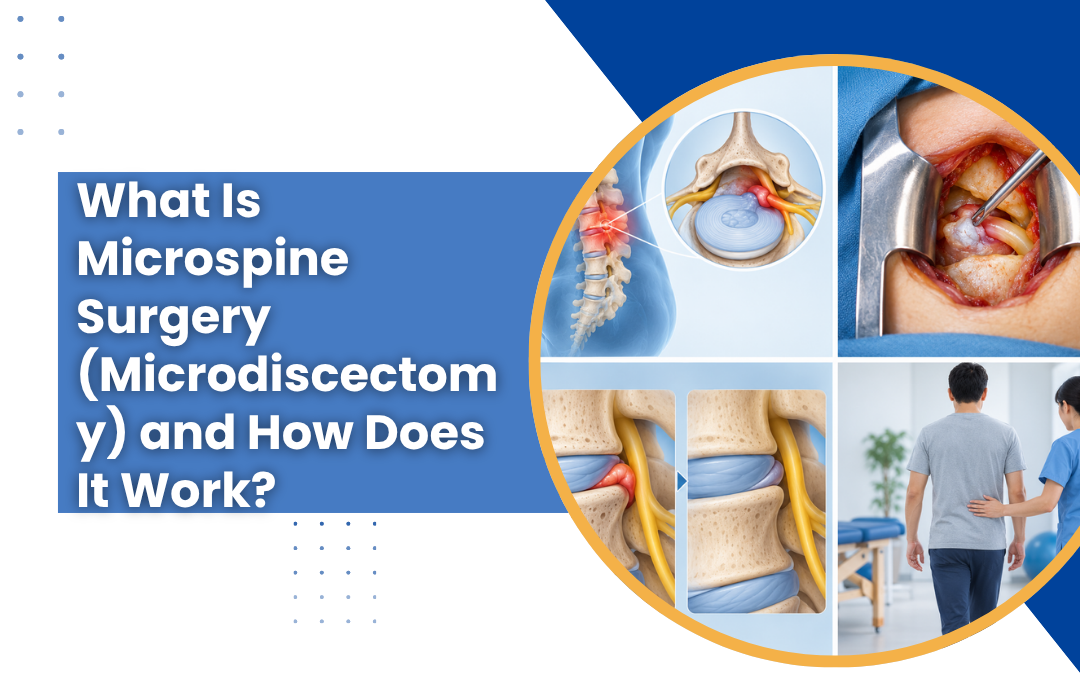
Microspine surgery, or microdiscectomy, is a minimally invasive procedure that relieves nerve pressure caused by a bulging or herniated disc. Using a microscope and a small incision, the surgeon removes only the disc fragment pressing on the nerve while preserving surrounding tissues. It is usually recommended when medicines, physiotherapy and rest fail to provide sufficient relief, based on the patient’s scans, symptoms and overall health.
According to Dr. Naveen Tahasildar, Spine Surgeon in Bangalore, at Sparsh Hospitals,“Most slipped discs settle without an operation. Microspine surgery is meant for the patient whose nerve is still compressed after a proper trial of treatment, or whose leg is growing weak. When the scan and symptoms match, a small, targeted operation can bring real relief.”
What Is Microspine Surgery and When Is It Recommended?
Picture a disc as a small jelly-filled cushion between two vertebrae. Years of lifting, sitting badly or just plain ageing can crack its tougher outer wall, and some of the jelly pushes out toward the nerves that run right behind it. That’s a slipped disc. The nerve gets irritated, and you feel it down the leg as shooting pain, tingling, a numb patch or a foot that doesn’t lift properly. Many people know this as sciatica.
Microspine surgery, also called microdiscectomy or microdecompression, removes the displaced bit of disc so the nerve gets its space back. It is done mostly in the lower back, simply because that’s where most herniations happen. Previously open discectomy needed a bigger cut. Here the incision is smaller, less muscle is disturbed and the surgeon gets a much better view, which is why it has become the standard operation for most lumbar disc herniations.
- Usually not the first step: Most slipped discs improve over weeks to a few months with medicines, physiotherapy and sometimes an injection. Surgery comes up when leg pain hasn’t moved after about six weeks of proper treatment, when weakness is setting in, or when bladder or bowel control is affected. You can read more about slipped disc treatment in Bangalore.
- When it can’t wait: A leg that is getting weaker by the day, trouble controlling your bladder or bowel, or numbness around the groin and inner thighs points to an emergency called cauda equina syndrome. Go to a hospital the same day.
What Are the Main Approaches to Microspine Surgery?
Every approach has one job: get the pressure off the nerve while disturbing as little as possible. Which one your surgeon chooses depends on where the disc has moved and how your spine is built.
- Conventional microdiscectomy: A cut of a few centimetres, the muscles pushed to the side, and the disc fragment lifted out under the microscope. Many patients are home the same day or the next morning.
- Tubular microdiscectomy: The surgeon passes a narrow tube through the muscle, which spreads the fibres apart instead of cutting them. Studies comparing it with the conventional method have found similar results.
- Endoscopic discectomy: A thin camera and fine instruments go in through a very small opening. The technique requires a surgeon experienced in the procedure and isn’t suitable for every disc level, L5-S1 being a common example.
- Microdiscectomy with fusion (rare): Only when the spine is also unstable, such as when a vertebra has slipped forward. That’s a separate decision, and your surgeon will explain it if it applies to you.
How Is Microspine Surgery Performed?
Getting ready for the procedure
Your MRI and X-rays have already shown which disc is pressing on the nerve. The team will tell you when to stop eating and drinking, usually from the night before, and which regular medicines to pause.
What happens in the operation theatre
Under general anaesthesia, you lie face down and an X-ray confirms the exact level. A small incision is made and the back muscles are gently moved aside. Looking through the microscope, the surgeon protects the nerve and removes the piece of disc pressing on it.
Waking up and the first day
The layers are stitched and you wake up in the recovery room. The operation often takes about an hour, and most patients are walking with support within a few hours to a day.
What Determines the Right Treatment and Recovery?
No two backs are alike, so no two plans are either.
- The scan and the symptoms: They have to tell the same story. A bulging disc on an MRI means little if it isn’t what’s causing your pain, and operating at the wrong level won’t help you.
- What bothers you most: Leg pain from a pinched nerve tends to improve more reliably than back pain on its own. Your surgeon should be honest with you about what to expect.
- Your general health: Age, weight, diabetes and smoking all affect how well you heal.
- Recovery: Many people are back at a desk job within a few weeks, and heavier activity usually follows after six to twelve weeks, depending on what your surgeon and physiotherapist advise. Numbness and tingling can take longer to fade than the leg pain.
- Risks: Infection, bleeding, a tear in the covering of the nerves and nerve injury can happen. Some people also get a repeat herniation, or pain that doesn’t go away completely. Ask about all of it before you decide.
- Cost: It changes with the technique, the hospital, the room category and how long you stay. Our page on spine surgery cost in India explains what to expect.
Key Takeaways
- Microspine surgery (microdiscectomy) removes the part of a slipped disc that’s pressing on a nerve, through a small cut and with the help of a microscope.
- It’s usually considered only after around six weeks or more of non-surgical treatment hasn’t worked. Growing weakness or loss of bladder or bowel control shouldn’t wait.
- Surgeons can use a conventional, tubular or endoscopic approach, depending on your anatomy and which disc is affected.
- You’re under general anaesthesia, the level is checked on X-ray, the offending fragment is removed and the small incision is closed. Many patients walk the same day or the next.
- Your scan, symptoms and general health, including whether you smoke, shape both the choice of operation and how well you recover.
Find out if microdiscectomy is right for you. Enquire now
FAQs
What is microspine surgery?
A minimally invasive operation, also called microdiscectomy, that removes the part of a herniated disc pressing on a spinal nerve.
How is microspine surgery performed?
Under general anaesthesia, through a small cut in the back, the surgeon uses a microscope to remove the disc fragment pressing on the nerve.
When is microspine surgery needed?
When leg pain, numbness or weakness carries on after weeks of treatment, or at once if weakness is growing or bladder or bowel control goes.
How long is recovery after microspine surgery?
Light activity within a few days to a few weeks, and full return to heavy activity in about six to twelve weeks.
References
1.NUH – Spine Surgery https://www.nuh.com.sg/care-at-nuh/services/orthopaedic-surgery/spine-surgery
Covers minimally invasive spine surgery, endoscopic discectomy and other spinal procedures
- Healthdirect Australia – Lumbar Microdiscectomy
Covers the surgical procedure, how it relieves nerve pressure, preparation, recovery, and possible complications.
Disclaimer
This article is for informational purposes only and does not replace professional medical advice, diagnosis, or treatment from a qualified spine specialist.