
Kyphosis Treatment in Bangalore
Kyphosis is an excessive forward curvature of the upper spine that causes a rounded or “hunched” appearance of the back. While a mild curve is normal, an exaggerated one can lead to chronic pain, stiffness, breathing difficulty, and, in advanced cases, visible deformity. Kyphosis can affect children during growth spurts, adults from poor posture and degenerative disc disease, or older adults due to osteoporotic vertebral collapse.
According to Dr. Naveen Tahasildar, a leading spine surgeon in Bangalore, treating kyphosis early prevents the curve from becoming rigid, and most patients respond well to bracing, targeted physiotherapy, and posture correction long before surgery is ever considered.
With over 18 years exclusively in spine care and 4,000+ procedures performed, Dr. Tahasildar brings fellowship training from Aarhus University Hospital, Denmark, and Epworth Hospitals, Melbourne, to patients across Bangalore. His approach combines accurate curve assessment with a graded treatment plan, so that patients receive the least invasive option that still restores function and stops the curve from progressing.
What Is Kyphosis?
Kyphosis refers to an abnormal, excessive outward curve of the thoracic (upper) spine, typically measuring more than 40–45 degrees on X-ray. A small forward curve in this region is normal and helps balance the spine’s natural S-shape; the problem begins when the curve exceeds healthy limits and the spine can no longer support the body in an upright, comfortable posture. It is a distinct condition from scoliosis, which is a sideways curve of the spine rather than a forward one.
There are several distinct types, and identifying which one a patient has is the first step in choosing the right treatment.
Postural Kyphosis:
The most common and mildest form, usually caused by slouching, prolonged desk work, or weak back muscles. It is flexible and correctable with posture training and physiotherapy.
Scheuermann's Kyphosis:
A structural, rigid form that develops during adolescent growth, where the front of the vertebrae grow slower than the back, creating wedge-shaped bones. It does not fully correct with posture alone and often needs bracing or, in severe cases, surgery.
Age-Related (Senile) Kyphosis:
Caused by spondylosis and osteoporotic compression fractures that collapse the front of the vertebrae over time. This is closely linked to conditions that weaken bone density with age, and often overlaps with patients who also need treatment for an existing vertebral fracture.
Left unmanaged, progressive kyphosis can restrict lung capacity, strain the neck and lower back through compensatory posture, and cause persistent pain that limits daily activity. Early evaluation with a clinical exam and imaging helps determine whether the curve is flexible, rigid, or actively worsening.
Who Needs Kyphosis Treatment?
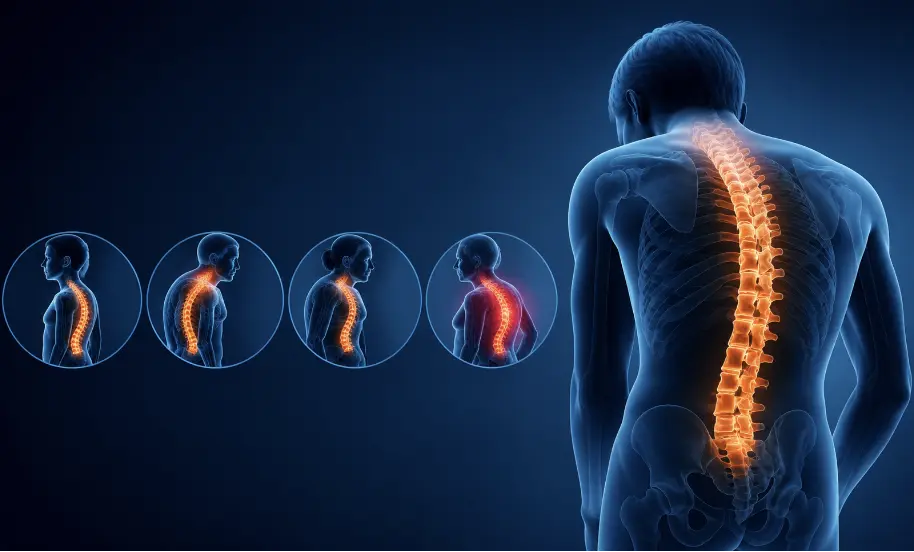
Not every rounded back needs active treatment. Dr. Tahasildar evaluates the curve’s flexibility, degree, cause, and rate of progression using clinical assessment, standing X-rays, and, where needed, MRI before recommending a plan.
Adolescents with Progressive Curves:
Teenagers with Scheuermann’s kyphosis who show a curve worsening during growth spurts benefit from early bracing to prevent it from becoming rigid. Monitoring every 4 to 6 months during the growth years is essential, since curves can change quickly at this stage.
Adults with Postural or Degenerative Kyphosis:
Adults with desk-bound lifestyles, weak core and back musculature, or persistent back pain often develop a flexible, correctable curve. These patients typically improve with targeted physiotherapy, ergonomic correction, and strengthening, without ever needing surgery.
Older Adults with Osteoporotic Kyphosis:
Patients with vertebral compression fractures from osteoporosis can develop a progressive stooped posture. When this is linked to an acute or recent fracture, procedures like kyphoplasty can restore vertebral height and reduce further curve progression, alongside bone health management.
Patients with Pain, Neurological Symptoms, or Severe Deformity:
Curves beyond 70–75 degrees, or those causing nerve compression, breathing restriction, or unrelenting pain despite months of conservative care, are candidates for surgical correction. These complex cases are evaluated the same way Dr. Tahasildar assesses facet arthrosis and other structural spine conditions, with imaging guiding every decision.
Trauma to your neck, such as fractures or dislocations from accidents or falls, can trigger sudden spinal cord compression. Even minor injuries may cause symptoms if you already have underlying degeneration.
Understanding the cause of your condition helps guide appropriate treatment and timing of care.
How Dr. Naveen Tahasildar Treats Kyphosis
Every kyphosis case is managed with a step-wise, evidence-based approach, escalating treatment only when a less invasive option has been given a fair trial and hasn’t worked.
Detailed Clinical and Radiological Assessment:
Standing X-rays measure the exact curve angle (Cobb angle) and identify whether the deformity is flexible or rigid. MRI is used when nerve involvement, disc degeneration, or an underlying tumour is suspected. Bone density scans (DEXA) are added for older patients to rule out osteoporosis as a contributing cause.
Physiotherapy and Postural Correction:
For flexible, postural kyphosis, a structured physiotherapy programme targeting the back extensor muscles, core stability, and shoulder mobility forms the foundation of treatment. Ergonomic changes at work and home, along with consistent exercise, produce measurable improvement over several months.
Bracing for Growing Adolescents:
In Scheuermann’s kyphosis with an actively progressing curve, a customised brace worn during growth years can halt or slow progression significantly, avoiding the need for surgery later. Bracing is most effective when started before the spine has finished growing.
Vertebral Augmentation for Fracture-Related Kyphosis:
When osteoporotic compression fractures are driving the curve, restoring the collapsed vertebra directly addresses both pain and the developing deformity. This is coordinated closely with the same minimally invasive kyphoplasty techniques used for isolated compression fractures.
Surgical Correction for Severe or Progressive Deformity:
When conservative measures fail, or the curve is severe and rigid, surgical correction using spinal instrumentation and, in select cases, osteotomy techniques restores alignment and relieves nerve pressure. Dr. Tahasildar’s fellowship training in complex spinal deformity allows him to plan these corrections with precision, minimising blood loss and recovery time. Post-surgical rehabilitation is structured to get patients moving safely within days.
Throughout treatment, whether conservative or surgical, bone health optimisation with calcium, vitamin D, and anti-osteoporosis medication where indicated is managed alongside the structural treatment. Patients considering surgery can also refer to spine surgery cost in India for a clearer picture of what to expect.
What Are the Benefits of Early Kyphosis Treatment?
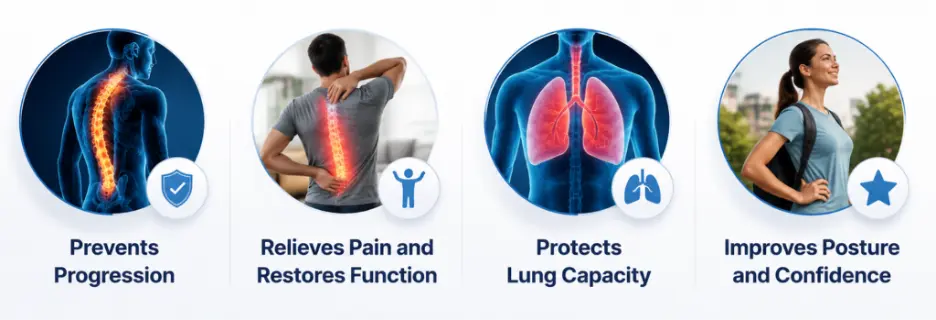
Addressing kyphosis before it becomes rigid or severe offers advantages that are difficult to recover once the deformity is established.
Prevents Progression:
Early bracing or physiotherapy can stop a worsening curve in its tracks, particularly during adolescent growth, avoiding the need for more invasive treatment later in life.
Relieves Pain and Restores Function:
Strengthening the back and correcting posture reduces the mechanical strain that causes chronic upper and lower back pain, improving day-to-day comfort and activity tolerance.
Protects Lung Capacity:
Severe thoracic curves can compress the chest cavity and reduce lung volume. Timely correction, especially in older patients with compounding fractures, helps preserve breathing capacity.
Improves Posture and Confidence:
Beyond the physical benefits, correcting a visible spinal curve has a meaningful impact on a patient’s confidence and quality of life, particularly for adolescents self-conscious about their appearance.
According to the Mayo Clinic, most cases of mild to moderate kyphosis do not require surgery and respond well to monitoring, exercise, and bracing when appropriate, reserving surgical correction for severe or symptomatic deformity.
Why Choose Dr. Naveen Tahasildar for Kyphosis Treatment?
Dr. Naveen Tahasildar has spent over 18 years focused exclusively on spine care, with fellowship training in minimally invasive spine surgery from Aarhus University Hospital, Denmark, and further specialisation in complex spinal deformity and paediatric scoliosis. Read more about Dr. Naveen Tahasildar’s training and experience. He has performed 4,000+ spine procedures across Sparsh Hospitals, Vasanth Nagar, and his clinic on Sarakki Road, bringing both surgical volume and a conservative-first philosophy to every consultation.
He has authored 26 peer-reviewed publications cited 250+ times and contributed a chapter on paediatric spinal deformity to a Springer textbook. He serves as faculty for AO Spine and reviews papers for national and international spine journals. Patients travel from across India and abroad, including the USA, the Middle East, Mauritius, and Bangladesh, for his opinion on complex spinal deformity cases; you can browse some of these outcomes in his case studies. With two accessible clinic locations in central Bangalore (Infantry Road) and south Bangalore (Sarakki Road), specialist kyphosis care is available across the city.
FAQs
1. Is kyphosis the same as a slipped disc or scoliosis?
No. Kyphosis is a forward curve of the upper spine, while scoliosis is a sideways curve. Both are spinal deformities but differ in direction and typical causes.
2. Can kyphosis be corrected without surgery?
Yes, in most cases. Postural kyphosis and many cases of Scheuermann’s kyphosis respond well to physiotherapy and bracing, especially when treated early.
3. At what age does kyphosis usually develop?
Postural kyphosis can develop at any age, Scheuermann’s kyphosis typically appears during adolescent growth spurts, and age-related kyphosis is more common after 60, often linked to osteoporosis.s includes permanent loss of fine motor skills, chronic balance issues (gait ataxia), and progressive paralysis as the compression worsens over time.
4. How is the severity of kyphosis measured?
Doctors use the Cobb angle, measured on a standing X-ray, to determine the degree of curvature and track whether it is progressing over time.
5. When is surgery necessary for kyphosis?
Surgery is generally reserved for severe curves (typically beyond 70–75 degrees), curves causing nerve symptoms or breathing difficulty, or cases that fail to improve with sustained conservative treatment.
References:
- https://www.nhs.uk/conditions/kyphosis/ — NHS
- https://www.mayoclinic.org/diseases-conditions/kyphosis/symptoms-causes/syc-20374205 — Mayo Clinic